First, decide what needs to happen to the lift
The right request depends on what happens after the equipment leaves the stairs. Tell the supplier which of these jobs you need before discussing a date or price.
| Your situation | Request | Resolve first |
|---|---|---|
| The lift is no longer needed | Permanent removal and an agreed destination for the equipment. | Whether there is a removal charge, buyback offer or disposal fee. |
| New carpet or other building work | Temporary removal followed by reinstallation. | Both visits, storage responsibility and access while the lift is unavailable. |
| A rental is ending | Return through the rental supplier. | Notice, the billing stop date and collection arrangements. |
| You are moving home | An assessment of relocation to the new address. | New-staircase fit before the existing installation is dismantled. |
Find the order, rental agreement and service records. If you inherited the equipment with a house or are helping manage an estate, establish who can authorize its removal. A lift being present in a property does not, by itself, tell you whether it was bought, rented or subject to another agreement.
For relocation, use the separate moving a stairlift guide. For a permanent removal, continue with the policy and scope checks below. These are planning questions to take to a provider; Hello Upstairs does not purchase used lifts or book removal work.
Published US buyback policies are very different
The following first-party statements were checked October 25, 2026. They illustrate why the original supplier and contract matter. They do not confirm acceptance of an individual lift or availability in your ZIP code.
| Source | Published position | Ask about your lift |
|---|---|---|
| Acorn US | Does not buy back unwanted stairlifts; offers guidance for private resale. [1] | What help is available and who can quote the physical removal? |
| Lifeway Mobility | Says its straight models may qualify for buyback, with payment depending on age, condition and use. [2] | Is this exact unit eligible, and what is the net offer? |
| Stannah direct US sales terms | For purchased straight and curved lifts: $500 buyback plus free removal within two years of installation; free removal without refund after two and through three years. Later removal may be at the buyer's expense. [3] | Do these terms govern your order, and which installation date applies? |
Stannah's general US removal page separately describes a removal fee and says it removes Stannah units only. [4] Have the contracting business reconcile its service quote with your actual purchase agreement. Do not apply a direct-sale benefit automatically to a distributor purchase or secondhand unit.
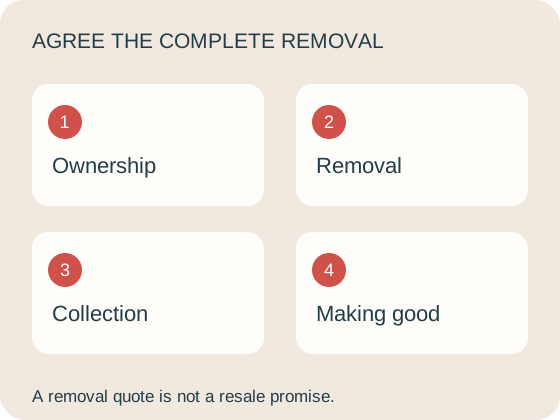
A refusal to buy the equipment is not a removal quote. Equally, an agreement to collect it does not establish that the company will pay you. Request one document stating the service charge, any payment to you and the resulting balance.
Prepare a short removal request
Collect enough information for the provider to identify the job without taking the lift apart. A photograph of an accessible external label, the complete staircase and each landing is more useful than a description such as “a fairly new chair.” Leave an inaccessible label for the technician.
- Equipment: manufacturer, model, serial number if available, straight or curved route, and whether it is indoors or outdoors.
- History: original installation date, supplier, available paperwork and any known faults or previous moves.
- Ownership: purchase, rental, inherited equipment or another arrangement; identify the person authorizing the work.
- Access: city and ZIP code, stairs to reach the property, parking restrictions and any building access appointment.
- Scope: permanent removal, temporary removal or relocation; whether you want the equipment kept, collected or considered for buyback.
- Timing: a move-out, flooring or other deadline and whether anyone still depends on the lift.
Describe a fault rather than operating the equipment to reproduce it for a video. Tell the provider about missing remotes, paperwork or parts, but do not dismantle covers to investigate. Ask whether a site visit is needed before a firm quote.
If the original installer is unavailable, contact the manufacturer for the appropriate service route. Ask the proposed technician to confirm that it handles this model and this type of job before arranging attendance. Keep the quote linked to the specific unit, rather than accepting a price for an unspecified stairlift.
Compare the complete removal cost
This guide does not assign a national removal price. A useful quote describes the work at your property and the destination of the equipment. Ask the business to mark every item as included, excluded or awaiting inspection.
- Assessment or call-out charges and whether they are credited against the job.
- Technician labor, removal of the agreed equipment, loading and transport.
- Any separate charge for difficult access, parking or an additional visit.
- Collection for reuse, recycling or disposal, including who accepts responsibility after collection.
- Any work required on the remaining fixing holes, stair finish, carpet or nearby electrical installation.
- Tax and any payment, credit or deduction associated with buyback.
Ask to see the removal total and the buyback amount separately. If a payment is conditional on inspection, keep it provisional in your budget. Do not deduct a hoped-for private resale price from the confirmed cost of clearing the stairs.
Agree what the staircase should look like afterward. “Remove the stairlift” is not a sufficiently precise promise to refinish stairs or replace carpet. Take ordinary condition photographs before the visit and record any agreed repair work in the scope.
If two quotes differ, compare exclusions before choosing. A cheaper collection offer may leave transport, repairs or a second visit unresolved. Ask what happens if the technician arrives and finds a different model, access problem or undisclosed fault.
Temporary removal and rental returns need their own plan
Stannah's US service page offers temporary removal for jobs such as carpeting and describes charges for both removal and reinstallation. [4] Ask for the complete two-visit scope, including storage and the return appointment, before booking the first visit.
Give the stairlift technician and flooring contractor the planned sequence. Ask whether the proposed stair finish changes anything about reinstallation and who will check that the site is ready. Settle which business reschedules if one stage slips. A removal appointment does not reserve a return date unless that is confirmed.
For rentals, Stannah's US rental page says removal is included in its rental arrangement. [5] That is a provider-specific inclusion; it does not establish the notice period, refund or billing-stop rule in another contract. Follow the rental supplier's return process rather than arranging an independent collection.
Ask for written confirmation of the agreed end date, outstanding amount, collection date and any equipment to return. If collection occurs later, have the supplier explain whether additional rent applies. If anyone still relies on the lift, arrange an appropriate access plan for the period between removal and a replacement or reinstallation.
Check a recipient before planning resale or donation
Separate three decisions: who removes the lift, who accepts the equipment and who would install it elsewhere. A willing buyer or recipient does not establish that the unit can be installed in their home. Have the receiving installer assess the proposal before promising the buyer a usable system.
Ask a potential buyer what is included in the offer: chair and carriage, rail, remotes, charger and documentation. State known faults and unknown history. Avoid describing a unit as refurbished unless you have a record of the work that supports that description.
Before offering a donation, obtain the recipient's acceptance criteria and a named collection arrangement. Confirm whether it accepts a complete installed lift, selected parts or neither, and who pays for removal. Do not treat a possible donation as a booked collection or an established tax value.
If no recipient has agreed to take it, ask the removal contractor for a disposal proposal. A dated receipt stating what was collected and where responsibility transferred is more useful than an informal promise to find someone later. The used stairlift buying guide explains the identification, fit and service questions a responsible recipient will need answered.
Close the job with a written handover
Before the visit ends, review the agreed scope with the technician. Confirm which equipment has left, whether any components remain, and what follow-up work is outstanding. Ask the contractor to explain any immediate restrictions on the work area.
Keep the removal invoice, equipment receipt, buyback payment record and condition photographs together. For a rental, retain the supplier's account-close confirmation as well as the collection receipt; the two documents answer different questions.
Ask about any separate service plan or recurring payment linked to the lift. Do not assume a removal appointment automatically cancels every agreement. If the unit will be reinstalled, record who has custody, the agreed storage arrangement and the next appointment in your stairlift service log.
Common questions
Can I have a stairlift removed for free?
Possibly, if your applicable purchase or rental terms include it. Confirm eligibility for your unit and whether transport, disposal and any home repairs are included. An advertised free-removal benefit does not establish a cash refund or buyback payment.
Will the manufacturer buy my stairlift back?
Policies differ, as the sourced comparison above shows. Ask about the model, original supplier, installation date and condition. Treat any proposed payment as unconfirmed until the company accepts the specific lift and gives you the amount and conditions in writing.
Can a stairlift be removed and put back after new carpet?
Ask a technician who supports your model about a temporary removal and reinstallation project. Arrange both visits and have the technician assess the planned flooring change. Include storage, access during the work and responsibility for delays in the agreement.
What if the stairlift was already in the house when I bought it?
Find the make, model and available paperwork, then establish ownership before authorizing removal. Ask the manufacturer for a service route if the original installer is unknown. Do not assume that the previous owner’s warranty, rental or buyback terms pass to you.
Does stairlift removal include repairing the stairs?
Ask for that work to be specified. Identify any agreed treatment of fixing holes, stair finish, carpet and surrounding areas. If repairs are excluded, arrange the appropriate follow-up work separately and include it in your total budget.
Should I dismantle it before the removal company arrives?
Leave dismantling to the agreed professional service. Provide model details and safe-to-take photographs, and follow the contractor’s preparation instructions. Taking components apart first can leave the next technician without a clear record of the original installation or its condition.
Evidence & accountability
Sources and research method
We reviewed the linked manufacturer, provider and public guidance. Published terms are attributed to that source and can change. These guides use original explanations and clearly marked hypothetical examples; we have not inspected the equipment or performed these installations.
Prepared with AI assistance. No independent installer or clinical review is claimed. A qualified installer must assess the home and proposed equipment. Read our research method and evidence standards.
- Acorn US: existing customers and resale ↗Checked October 25, 2026
US manufacturer resale statement; no individual removal quote obtained.
- Lifeway Mobility: stairlift FAQs ↗Checked October 25, 2026
Conditional buyback statement; acceptance of a specific unit remains unverified.
- Stannah US: general terms and conditions of sale ↗Checked October 25, 2026
Section 3; confirm the terms applicable to the signed order.
- Stannah US: stairlift removal ↗Checked October 25, 2026
US service overview, separate from an individual contract or quote.
- Stannah US: stairlift rental ↗Checked October 25, 2026
Provider rental inclusion; other suppliers may use different terms.
Keep planning
Melt Media Group reviews your request and follows up about installer options. We identify the proposed company and ask before sharing your details.