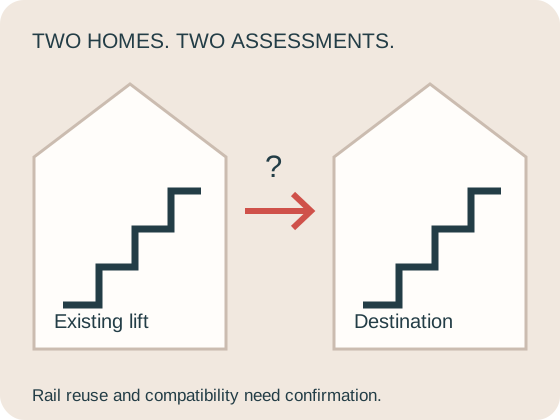
Assess the destination before removing the current lift
Treat relocation as a new installation project using equipment you already have. Stannah's US removal page says a move to a new house is likely to require replacement or adjustment to fit the new stairs. [1] That is a reason to get an assessment, not a promise that any particular component can be reused.
Begin with the original supplier and the new ZIP code. Ask whether it can assess both properties or coordinate with a business that supports the same model at the destination. Establish who will take responsibility for the completed installation if different companies handle removal and fitting.
Request three clear answers before scheduling dismantling: which components the installer proposes to reuse, what must be replaced, and whether it will support the completed system. If any answer depends on inspection, mark the proposal as conditional and agree when the decision will be made.
Keeping the current lift available while those questions are resolved may help avoid a preventable access gap. Plan around the household's needs and the actual move dates. Hello Upstairs provides research and quote-planning guidance; it does not arrange stairlift transport, removal or reinstallation.
Confirm ownership and the permission to move it
Locate the purchase or rental agreement before treating the lift as household furniture. Stannah's direct US terms, for example, retain title until the purchase price is fully paid. [2] Your own documents must establish the position for your equipment.
Use the following questions to distinguish arrangements that can otherwise look similar:
- You own it and are moving: which installer will assess reuse and what written coverage will apply at the new address?
- You rent it: will the supplier authorize relocation, arrange a different rental at the destination, or require return and a new agreement?
- You are buying a used lift: has a receiving installer accepted the specific unit and quoted installation before you pay the seller?
- The lift comes with a house: which ownership documents, service records and agreements are actually being transferred?
Stannah's US rental page includes removal in its rental offering. [3] That inclusion does not establish permission to move a rented unit yourself or a right to installation at another property. Ask the rental business for a written plan covering the old and new addresses and any gap between agreements.
Keep a property owner's permission separate from equipment ownership. If the new home is rented or has association requirements, establish who can approve the proposed installation and related work before committing to the move.
Check the rail separately from the chair and carriage
A reusable seat or drive unit does not establish that the entire installation can move unchanged. Bruno describes the Elite Curved rail as made for the particular staircase. [4] Do not turn that model-specific fact into a claim that every curved system is identical—or that an existing rail will fit another home.
Ask the installer to identify the rail system and document its proposal. Can it use any existing sections? Does it need a newly supplied rail or other approved components? Will the current carriage and controls be supported in the proposed configuration? These questions need answers for the model and destination, not a general promise about “curved lifts.”
A straight route also needs assessment. The number of steps alone does not show the full route, stopping positions, available space at each end or the arrangement of doors. Have the provider assess the staircase instead of buying extra rail or assuming a shorter staircase is automatically compatible.
Separate the decision into reusable components, replacement components and unresolved items. Ask who disposes of or retains parts that will not be reused. If the quote depends on a later inspection, request an alternative price or decision point before paying for transport.
Give the installer a brief for both homes
Lifeway's installation guide describes assessing the user's needs, measuring the staircase and examining the landings before recommending equipment. [5] Use that as an example of the assessment to request at the destination; a prior successful installation does not answer those questions for the new home.
| Existing installation | Proposed destination |
|---|---|
| Make, model, serial number and original installation date. | Address, staircase route, landings and doors near the route. |
| Photos, available service history and known faults. | The intended user's seating, transfer and control needs. |
| Equipment still installed, previously removed or stored. | Proposed parking and transfer positions, nearby circulation and charging arrangements. |
| Removal access, building appointments and move-out deadline. | Access for installation, property permissions and move-in deadline. |
Photos can help the provider decide what assessment is needed, but do not present a homeowner's measurements as an approved installation design. Ask who will verify dimensions and decide the permitted configuration. If circumstances have changed since the original purchase, explain what the user now needs rather than requesting the same setup by default.
Ask the receiving installer to identify any electrical preparation, building work, permit or inspection questions that apply to the property. Record who checks the local requirements and who completes the work. This is a project checklist, not a statement that every relocation requires the same approvals.
Compare a complete move with a complete replacement
The decision should use what you would pay from today onward. The original purchase price does not tell you the cost of making the equipment suitable for another property. Request comparable written scopes for relocation and replacement.
| Cost or responsibility | Relocation proposal | Replacement proposal |
|---|---|---|
| Existing home | Assessment, removal and any agreed stair repairs. | Removal of the old lift and any agreed stair repairs. |
| Equipment | Inspection, proposed reused parts, new rail or components and necessary service work. | Specified lift, rail, features and condition. |
| Logistics | Packing, transport, storage, custody and damage responsibility. | Delivery and any access charges. |
| New home | Preparation, installation, commissioning and demonstration. | The same agreed preparation and handover scope. |
| After installation | Written parts, labor, travel and service terms for the relocated unit. | Written coverage and local service terms for the replacement. |
Add taxes, inspection charges and any excluded work where applicable. Keep unknown amounts visible instead of entering zero. Ask how the quote changes if the inspection identifies a component that cannot be reused or supported.
Compare timing and service as well as the total. A lower relocation price with unresolved parts or support is not yet a complete alternative. Treat a possible sale or buyback of the existing lift separately until there is a firm offer; the removal guide explains that distinction.
Agree the sequence, custody and access gap
Set out the project in order: destination assessment, acceptance of the equipment, required parts, removal, transport or storage, new-site preparation, installation and handover. Put a responsible business and an agreed date or dependency beside each stage.
Ask what happens if possession of the new house is delayed or the destination is not ready. Who stores the lift, under what manufacturer-approved conditions, and at whose cost? Who documents its condition when it changes hands? Which business addresses transport damage or missing components?
Have the stairlift contractor specify how equipment is prepared, handled and delivered. Do not ask ordinary furniture movers to dismantle the system without a professional plan. Request a component inventory and photographs from the responsible contractor rather than disconnecting parts yourself.
Plan the period without the lift before committing to removal. Consider when the user will leave the old property, when the new installation is available and what happens if commissioning is delayed. If care or discharge arrangements depend on stair access, discuss that gap with the relevant care team.
Get a new handover and a clear service contact
Stannah's US registration page says its warranties are nontransferable and that distributor terms may differ. [6] That statement concerns warranty transfer; it does not, by itself, settle coverage when the same owner changes address. Ask the warranty issuer to confirm the effect of your proposed move.
Request written answers covering the named unit, the new address, who may do the work, any parts newly supplied, and the start and end dates of each coverage. Keep installation workmanship coverage separate from the original equipment warranty. Do not assume that paying for reinstallation starts a new product warranty.
Lifeway's installation guide describes an operating demonstration and a care checklist at handover. [5] Request a fresh demonstration in the new setting, plus the installer's completed checks, operating instructions and service contact.
Record the new installation date, reused and replaced components, outstanding work and support details in the stairlift service log. Keep the earlier history as well. A move adds a new chapter to the equipment record; it does not make its previous age or service history disappear.
Common questions
Can any stairlift be moved to another house?
No universal answer applies. An installer needs to identify the model, assess condition and support, and evaluate the new staircase and user. Ask for a written list of reusable and replacement components before removing the existing installation.
Can I reuse a curved stairlift rail?
Do not assume it. Have the installer identify the rail system and assess whether any reuse is appropriate for the new route. A usable chair or carriage does not prove that its old rail can be used at the destination.
Is moving a stairlift cheaper than buying another one?
It depends on the completed scopes. Compare removal, transport, any storage, new parts, installation and future service with the replacement proposal. Leave uncertain resale proceeds out of the calculation until a buyer makes a firm offer.
Can I move a rented stairlift?
Ask the rental supplier before making arrangements. Request written confirmation of whether it permits relocation, who performs the work, and what changes in rent, service and return terms. The alternative may be returning one unit and arranging a suitable rental at the new address.
Does the warranty move with the stairlift?
Have the warranty issuer confirm coverage for the new address and proposed work. Keeping the same owner is different from selling the equipment to another person. Ask separately about original equipment coverage, replacement parts and the reinstallation workmanship.
Who should handle removal and reinstallation?
Start with the original supplier or manufacturer’s service route. Confirm that each proposed business supports the exact model and accepts its part of the project. If two businesses are involved, agree who resolves compatibility, transport and commissioning issues before the first visit.
Evidence & accountability
Sources and research method
We reviewed the linked manufacturer, provider and public guidance. Published terms are attributed to that source and can change. These guides use original explanations and clearly marked hypothetical examples; we have not inspected the equipment or performed these installations.
Prepared with AI assistance. No independent installer or clinical review is claimed. A qualified installer must assess the home and proposed equipment. Read our research method and evidence standards.
- Stannah US: removal and moving a stairlift ↗Checked October 25, 2026
US relocation statement; no assessment of an individual unit.
- Stannah US: general terms and conditions of sale ↗Checked October 25, 2026
Section 5 title provision; the signed agreement controls.
- Stannah US: stairlift rental ↗Checked October 25, 2026
Published rental scope; does not establish relocation authorization.
- Bruno: Elite Curved indoor stairlift ↗Checked October 25, 2026
Model-specific rail description; not a universal reuse decision.
- Lifeway Mobility: stair lift installation and service ↗Checked October 25, 2026
Installation assessment and handover example, not a relocation offer.
- Stannah US: warranty registration ↗Checked October 25, 2026
Warranty transfer statement; confirm same-owner relocation separately.
Keep planning
Melt Media Group reviews your request and follows up about installer options. We identify the proposed company and ask before sharing your details.