Start with the right manual and a named service contact
Collect the model, serial number, installation date, installer and owner guide before creating a maintenance routine. Use existing paperwork or a label that can be read from a safe position. Do not dismantle equipment or lean over the stairs to find a number.
Bruno provides an owner-manual lookup and directs service and installation questions to its dealers; it distinguishes owner materials from installer manuals. [1] Acorn Club gives customers access to their model guide, documents and service history. [2] Keep a copy of the relevant instructions with the lift’s records.
Ask the responsible supplier to confirm the manual revision for the actual unit and its options. A matching brand name is not enough: a different rail arrangement, powered seat feature or generation can change the instructions you need. If a general article and your manual appear to disagree, ask support to resolve that specific point.
Keep two contacts if they differ: the company responsible for the service agreement and the company that will attend. Record whether it accepts this exact model at your address and how to report a fault. This guide is based on published sources and practical planning; we have not tested equipment or obtained an independent technician review.
Confirm the professional schedule, then set the reminder
Acorn recommends professional service every 12 months. [3] The US Siena 600 guide linked by Stannah recommends 12-month intervals for a private residence. [4] Those are attributed examples, not one schedule for every brand, model and installation.
| Confirm with the provider | What to record |
|---|---|
| Applicable instructions | Model, manual revision and any written service requirements. |
| Previous visit | Date and whether it was a full planned service or a specific repair. |
| Next planned visit | Agreed due date, who books it and how much notice is needed. |
| Different usage or conditions | Whether the provider changes its recommendation for this installation. |
| Coverage conditions | Which maintenance evidence the applicable warranty or contract requires. |
A repair visit should not silently reset your annual calendar. Ask whether the technician completed the planned service as well as the fault repair, and obtain that distinction in the job record.
Choose a reminder early enough to arrange attendance; the reminder itself is not a booking. If you discover an overdue service, contact the provider for guidance and an appointment. Do not invent a grace period or assume the equipment is fit for continued use because a date has only recently passed.
Use the approved cleaning method for this model
Cleaning instructions illustrate why a universal recipe is unhelpful. Acorn’s US care article describes a soft, dry cloth for accessible rail surfaces and says not to add water, oil or abrasive products unless the model guide approves them. [5] The published US Siena 600 manual describes damp-cloth cleaning. [4] Use the instructions confirmed for your own equipment.
Have the installer demonstrate what the owner may clean, how to leave the lift before doing so and which areas must be left to a technician. Ask for the product name or cleaning method in writing. “Keep it clean” is incomplete if the household does not know which surfaces or materials that instruction covers.
Divide the household task into the equipment’s approved owner care and ordinary housekeeping around it. Avoid placing new storage, furniture or cables in the boarding and travel areas. If cleaning would require an awkward position, reaching into the mechanism or moving equipment by hand, leave that part for the service business.
Do not assume that a dry surface needs lubricant or that a household spray will improve a squeak. Report the change and ask the provider to assess it. Keep any cleaning supplies away from the lift until their use has been confirmed; a product suitable for nearby furniture may not be suitable for the equipment.
Know the normal indications and report what changes
At handover or the next visit, ask the technician to show the normal parked position and charging indication, ordinary controls and any option-specific behavior. Photograph a normal display only if it is safely visible, then label the image with the model and date.
Acorn’s operation article explains that its batteries recharge at the designated charging position. [6] For another model, have its supplier identify the correct arrangement. A convenient place to leave the chair is not necessarily the position the instructions require.
During ordinary use, pay attention to a change you can describe without testing the machinery: when it began, where on the route it occurs and what the display says. Do not deliberately obstruct the lift, run repeated test journeys or defeat a sensor to see whether a symptom disappears.
If movement, a part or a warning seems abnormal, stop using the affected equipment and contact support. Acorn specifically reserves internal adjustments and repairs for trained technicians. [5] If someone is stranded and cannot leave safely, seek emergency assistance instead of attempting an improvised transfer on the stairs.
The battery guide explains why a charging concern is not automatically a failed battery. Use the repair guide to prepare a concise fault report.
Make the professional visit useful and the price clear
Before booking, ask what the planned service includes, whether it covers the installed options and whether replacement parts are extra. Agree how the technician will seek approval if it identifies chargeable work. A maintenance visit, diagnostic appointment and repair can have different scopes.
- Send ahead: model details, service history and a short list of unresolved observations.
- Clarify access: arrival arrangements and anything the business needs to know to attend.
- Clarify interruption: which parts of the household’s route will be unavailable during the visit.
- Clarify charges: visit price, travel, parts, tax and any additional work requiring approval.
- Ask for evidence: the completed service record and any required follow-up.
Do not sign a blank completion description. Ask the technician to distinguish work performed, observations made and work recommended. If a part is ordered, record whether the lift is available for use meanwhile and the provider’s specific instruction.
Keep warranty questions separate from the maintenance checklist. Acorn’s servicing page ties its lifetime motor and gearbox warranty to annual Acorn-engineer servicing, subject to the applicable terms. [3] That condition does not establish another brand’s coverage or make every expense free. Read your actual agreement alongside our warranty guide.
Plan ahead for an absence or changes around the stairs
Ask the service provider what to do before a long absence and before bringing an unused lift back into service. Request instructions for this model and duration, including power, charging and any return check. Do not follow a shutdown sequence from an unrelated lift.
Tell the installer before carpet replacement, decorating, electrical work or changes to doors near the lift. Ask which work needs coordination and who may move or protect the equipment. A household contractor’s willingness to work around the rail is not the same as permission to alter it.
For an outdoor installation, use the model’s environmental and cover instructions and discuss any seasonal concerns with the supplier. Avoid transferring an indoor cleaning routine to exposed equipment or assuming a cover resolves every weather-related issue.
Hypothetical example: a household plans to replace stair carpet while a lift is installed. It asks the lift company and flooring contractor to agree responsibilities before booking either job. Afterward, it records who assessed the lift and whether further work remains. This is a planning example, not a completed installation we observed.
If the user’s needs change, arrange the appropriate assessment as well as any equipment work. A completed mechanical service does not determine whether the person can still use the existing seat and boarding arrangement comfortably and appropriately.
Keep a service log that separates observations from findings
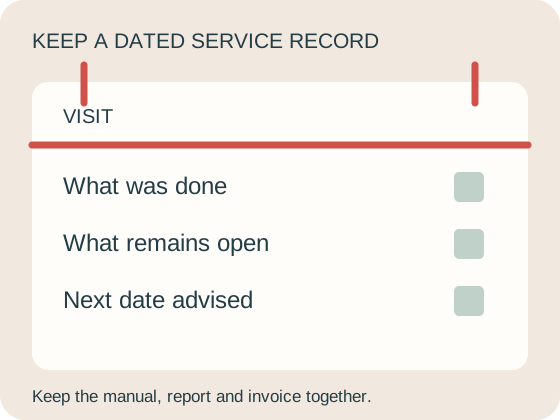
Use our printable stairlift service log for the equipment details, dated entries, notes and next service. It works in your browser; it does not save a record or book a visit. Print it or export the CSV before leaving the page if you want to retain your entries.
| Record type | Useful detail | Keep separate |
|---|---|---|
| Owner observation | Date, visible message and circumstances. | A guessed technical diagnosis. |
| Service completed | Business, job number, completed work and invoice. | A future appointment or a reminder. |
| Technician finding | Attributed finding and agreed action. | Unconfirmed parts or a promised outcome. |
| Follow-up | Who must act, when and whether it has happened. | The assumption that someone else booked it. |
Attach invoices, the service report and relevant written instructions to your retained copy. A personal log helps organize the history; it does not replace the provider’s records or certify the equipment. Keep account credentials and unnecessary medical details out of it.
When changing service companies, pass on the equipment identity, completed work and outstanding concerns. Ask the new business what it will need to accept responsibility for future service rather than expecting it to infer the history from a paid invoice.
Common questions
How often does a stairlift need servicing?
Confirm the interval for the exact model and installation with the service provider. The examples above include annual private-home service, but they are not a universal rule. Record the agreed next date and who will arrange the appointment.
Can I maintain a stairlift myself?
Follow the owner tasks in the correct manual and the supplier’s demonstration. Do not remove covers, adjust the rail, alter wiring or work on safety systems. Routine housekeeping and a record of observations do not replace professional servicing.
Can I put oil or a household polish on the rail?
Do not choose a product by guesswork. Cleaning and lubrication requirements depend on the model and the specific surface. Ask the supplier what owners may use and what it reserves for a technician.
Is an annual service the same as an inspection or a repair?
Do not treat the labels as interchangeable. Ask what the booked visit includes, whether any required formal inspection is separate, and whether a diagnosed repair needs additional authorization. Keep the completed scope in the record.
Does a lift that is rarely used still need a service plan?
Ask the responsible provider for the schedule and storage guidance for that unit. Low use is not permission to ignore its instructions or coverage conditions. If the last service is unknown, record that honestly and arrange advice.
Will the service log remind me or book an appointment?
No. The service log is a browser-based record you can print or export. It does not save your entries, contact a provider or schedule reminders; make the booking with the service company.
Evidence & accountability
Sources and research method
We reviewed the linked manufacturer, provider and public guidance. Published terms are attributed to that source and can change. These guides use original explanations and clearly marked hypothetical examples; we have not inspected the equipment or performed these installations.
Prepared with AI assistance. No independent installer or clinical review is claimed. A qualified installer must assess the home and proposed equipment. Read our research method and evidence standards.
- Bruno: owner manuals and dealer service questions ↗Checked October 25, 2026
Public owner-document route; no installer manual, account or unit-specific document accessed.
- Acorn US: customer documents and service history ↗Checked October 25, 2026
Public description of the portal; no customer account accessed.
- Acorn US: service recommendation and warranty condition ↗Checked October 25, 2026
Manufacturer’s current published terms summary; no service booking or individual coverage verification.
- Stannah US: Siena 600 owner guide ↗Checked October 25, 2026
US model guide, pages 2 and 16. Match your unit’s revision.
- Acorn US: at-home maintenance guidance ↗Checked October 25, 2026
Published July 30, 2026. Used for the owner/technician boundary and cleaning distinction, not a universal procedure.
- Acorn US: operation and charging ↗Checked October 25, 2026
Published September 11, 2026. Charging-position principle only; no outage-capacity guarantee adopted.
Keep planning
Read local installation research
Denver, CO · Chicago, IL · Phoenix, AZ · All cities
Prepare your stairlift enquiry ↗Melt Media Group reviews your request and follows up about installer options. We identify the proposed company and ask before sharing your details.