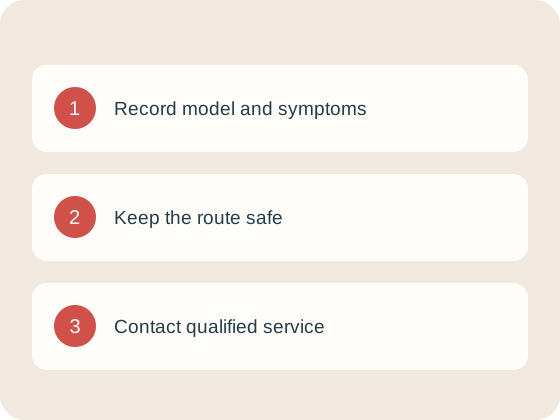
First, deal with the person and access needs
If someone is stranded on the lift, injured or unable to get off safely, seek emergency assistance. Do not attempt an improvised transfer on the stairs. For a fault without immediate danger, stop using the affected equipment and contact the appropriate service provider.
Acorn's current aftercare guidance says persistent problems need support and warns against electrical repairs or bypassing safety features. [1] A website cannot diagnose an individual fault from a beep, a photograph or the age of a battery.
Tell support whether the lift is the household's only usable route to essential rooms. Ask when it can assess the problem and when it expects to know whether parts are required. An appointment to diagnose is not automatically an appointment that will complete the repair.
Arrange a workable access plan with family, carers or the relevant care team while the lift is unavailable. Keep the medical or transfer decision separate from the equipment fault. If a person's mobility has changed, a functioning lift may still need a suitability reassessment.
Find the service route for the brand and installer
| Equipment | Published starting route | Confirm before booking |
|---|---|---|
| Acorn | Acorn publishes a servicing help desk; its contact page gives 1-866-873-6574 and Acorn Club messaging. [2] [3] | Model, serial number, address, coverage and appointment availability. |
| Stannah | The US support page links to a technical-assistance request. [4] | Whether the lift was bought direct or through a distributor, and who handles this unit. |
| Bruno | Bruno directs service questions to a local authorized dealer and provides an owner-manual lookup. [5] | Whether the dealer supports your exact model and will take over service if necessary. |
If the original installer is no longer available, ask the manufacturer to identify an appropriate service route. Give the model and installation location, not just the brand. Do not assume a business can obtain the needed parts because it advertises stairlifts generally.
Our local guides can help identify businesses to contact. They do not represent verified repair appointments, current stock or an emergency dispatch service. Confirm the scope with the business itself before making arrangements.
Prepare a fault report without opening the equipment
A concise record helps the service desk decide who should attend and what information it still needs. Use existing documents or an externally visible label if it can be read safely. Do not move into an awkward position on the stairs to obtain a photograph.
- Identity: manufacturer, model, serial number and original installer.
- Timing: when it last worked normally and when the symptom started.
- Display: the exact visible code or message, rather than a guessed interpretation.
- Location: where the chair stopped and whether anyone is on it.
- Observation: sound, movement or charging indication that changed.
- History: recent power outage, service work or a similar earlier incident.
- Documents: installation date, service records and applicable coverage.
Use neutral language: “The display shows this message and the chair stopped here” is more useful than “the motor is broken” unless a technician has diagnosed it. Keep photographs free of unnecessary personal or medical information when sharing them.
Follow only the owner-level instructions for the correct model or direct guidance from its support team. Do not remove covers, alter the rail, bridge a sensor, reprogram controls or disconnect internal batteries. Similar-looking lifts can have different operating and service procedures.
Do not turn a symptom into a diagnosis
Bruno describes more than one possible reason for unwanted beeping, including a seat-position reminder and a charging issue. It also says battery life varies rather than giving one guaranteed replacement interval. [6] Those examples show why a sound or an age estimate cannot establish which part needs replacement.
Ask support what observations it needs and record what it tells you. If it suggests an owner-level check, confirm that the instruction applies to the exact model and that it can be performed safely. When uncertain, wait for the technician instead of experimenting.
If a repair estimate names a battery, charger or control component, ask what was diagnosed and what will be checked after replacement. Request the part description, warranty and total fitted cost. Do not order a visually similar battery or component as a substitute for a model-specific assessment.
Repeated faults deserve a written history. Record dates, technician findings, work completed and whether the same symptom returned. That helps the next discussion focus on the unresolved problem rather than treating each call as an unrelated event.
Ask what the diagnostic visit and repair will cost
The reviewed sources do not establish a national average repair bill. The cost depends on the diagnosed problem, applicable coverage and local service terms. Ask for the diagnostic charge before booking and the repair estimate before authorizing additional work.
| Charge | Question for the service business |
|---|---|
| Callout and travel | Is this a fixed charge, a mileage charge or included in another fee? |
| Diagnosis | What does the visit cover, and is any fee credited toward repair? |
| Labor | Is there a minimum, an hourly rate or a quoted task price? |
| Parts | Which parts are required, what do they cost and are they available? |
| Return visit | If a part must be ordered, does another visit carry another charge? |
| Coverage | Which lines are approved under warranty or a service plan? |
| Completion | What checks and written service record will be provided? |
Agree a limit on additional work that requires your approval. Keep taxes, deposits and payment timing clear. A verbal statement that a component is covered does not establish whether travel and labor are included; the warranty guide explains that distinction.
Compare a diagnosed repair with a complete replacement
Request a repair proposal that identifies the fault, available parts and warranty on the work. If replacement is suggested, ask why: repeated faults, unavailable parts, damage, a different access need or the economics of the proposed work. Age alone is not a complete explanation.
Then compare the complete alternatives. A new-lift proposal needs assessment, equipment, rail, installation, removal of the old unit and any additional preparation. A repair proposal needs the work required to restore the assessed system, not only the price of one component.
Ask each provider what remains uncertain and when it will know more. A part that might be available and a confirmed installation slot are different levels of certainty. Keep both the financial decision and the expected interruption to household access visible.
If the person now has difficulty sitting, transferring or operating the lift, request an appropriate professional reassessment rather than assuming new equipment of the same type resolves the issue. Technical condition and personal suitability are separate decisions.
Use the purchase-cost guide for replacement quotes and the used-lift guide if a reconditioned unit is proposed. Neither route should be accepted without an identified model and support arrangement.
Keep the repair record and the next service date
Before the technician leaves, ask what was found, what was changed and whether any further work remains. Request the service record and an explanation of the normal operation and indicators relevant to the work. Report anything you still do not understand.
Ask when the next planned service is due and how it relates to your manufacturer's instructions or agreement. Acorn recommends professional service every 12 months. [2] That example does not replace the schedule for another model.
Save the invoice, replaced-part description, work warranty, case number and next steps with the installation paperwork. If a fault returns, tell support it is a repeat and refer to the previous job number. Ask whether a follow-up is part of the prior work or a new chargeable visit.
This guide helps prepare and compare service requests. We have not inspected your equipment, tested repair providers or verified response times. The technician working on the identified model must determine the fault and the appropriate repair.
Common questions
Who can repair my stairlift?
Start with the installer or manufacturer’s support route. Confirm that the business services the exact make and model at your address, can obtain the relevant parts and will explain its charges. General stairlift sales coverage is not proof of repair capability.
How much does stairlift repair cost?
These sources do not establish a national repair average. Request the callout and diagnostic price first, then a written estimate for the diagnosed work. Separate parts, labor, travel, return visits and any approved coverage.
Why is my stairlift beeping?
A beep does not identify one universal fault. Record the display and circumstances, consult the owner instructions for the exact model and contact support if unresolved. Do not silence or bypass a safety device to keep using the lift.
Should I replace the batteries myself?
Ask the manufacturer or responsible service provider to identify the correct procedure and scope for your model. This guide does not provide internal battery-replacement instructions. A charging symptom alone does not prove the batteries are the cause.
Is a 24-hour helpline a same-day repair promise?
No. Telephone availability, diagnostic attendance, part availability and completed repair are separate matters. Ask the provider to state what it can commit to and what the applicable service agreement promises.
What if the original installer has closed?
Contact the manufacturer with the model, serial number and location, and ask for a suitable service route. Have the replacement business confirm whether it will take on the unit, what inspection is needed and what charges or coverage apply.
Evidence & accountability
Sources and research method
We reviewed the linked manufacturer, provider and public guidance. Published terms are attributed to that source and can change. These guides use original explanations and clearly marked hypothetical examples; we have not inspected the equipment or performed these installations.
Prepared with AI assistance. No independent installer or clinical review is claimed. A qualified installer must assess the home and proposed equipment. Read our research method and evidence standards.
- Acorn US: October 2026 aftercare guidance ↗Checked October 24, 2026
Owner-level escalation and professional repairs; no technical repair procedure reproduced.
- Acorn US: servicing and repairs ↗Checked October 24, 2026
Help-desk route and 12-month service recommendation; no attendance guarantee inferred.
- Acorn US: current contact and Acorn Club route ↗Checked October 24, 2026
Public phone and messaging route only; no contact or appointment made.
- Stannah US: technical assistance ↗Checked October 24, 2026
Official US technical-assistance link; service eligibility and response time not verified.
- Bruno: owner manuals and dealer service route ↗Checked October 24, 2026
Manufacturer distinguishes owner manuals from installer materials and directs service questions to dealers.
- Bruno: stairlift questions on beeping and batteries ↗Checked October 24, 2026
Examples illustrate diagnostic uncertainty; no fault diagnosis or battery lifespan promised.
Keep planning
Read local installation research
Los Angeles, CA · Atlanta, GA · Minneapolis, MN · All cities
Prepare your stairlift enquiry ↗Melt Media Group reviews your request and follows up about installer options. We identify the proposed company and ask before sharing your details.