Start with the tax year and the type of benefit
This guide uses Publication 502 (2025) and the 2025 Schedule A instructions, the editions displayed by the IRS when checked October 25, 2026. It does not substitute 2025 figures for a later year's return. Before filing, use the instructions and any updates applicable to the year being prepared.
The IRS distinguishes deductions, which reduce taxable income, from credits, which reduce tax due. [1] A statement that an expense is “tax deductible” therefore does not mean the government reimburses the purchase price.
Ask the person preparing your return to separate three questions: does the expense meet the relevant medical-expense rules, what amount can be included, and does including it change the completed return? An installer can supply a factual invoice and equipment description; that documentation is different from a decision about your tax position.
This guide concerns the federal medical-expense deduction. It does not establish a state credit, business deduction, insurance benefit or grant. If another program is involved, bring its award and payment documents to the same review so the funding is considered together.
Read the home-improvement rule without assuming every lift qualifies
Publication 502 allows certain home equipment or improvements primarily for medical care. For permanent improvements, an increase in property value reduces the includible cost. Its examples mention porch and other lifts while noting that elevators generally add value. [2]
The publication does not name every stairlift model or decide the facts of your installation. Its capital-expense section also excludes additional costs for architectural or aesthetic motives. [2] Do not translate a general list of adaptations into a promise that the whole project qualifies.
For an appointment with your tax professional, prepare a factual project description: what equipment was installed, who uses it, why it was obtained, and which other works were included. Ask what support is needed for the medical purpose and whether the property-value question requires additional evidence.
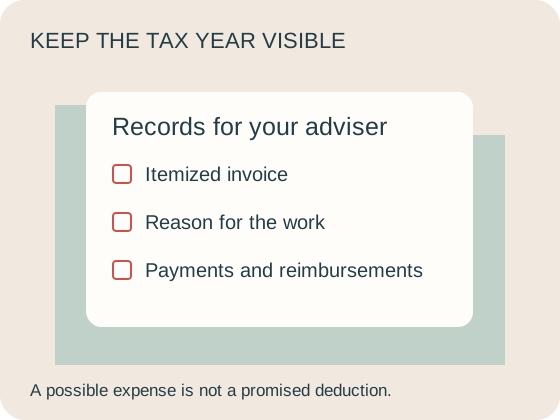
Request separate invoice lines for the lift, rail, fitting, related construction and optional design upgrades. An itemized invoice makes those questions easier to investigate; it does not itself classify a cost as deductible. If a supplier combines several projects in one price, ask for a reasonable written breakdown while the details are still available.
Use the IRS capital-expense worksheet with professional guidance where relevant. Avoid substituting the resale price of the lift, its original retail price or a casual estimate of the house's value for the evidence the return requires.
An includible expense is only the start of the deduction calculation
The 2025 Schedule A instructions limit the medical deduction to the portion of qualifying medical and dental expenses above 7.5% of adjusted gross income. They also explain the comparison between itemized deductions and the standard deduction. [3]
2025 arithmetic illustration only: assume adjusted gross income of $60,000 and that a preparer has already established $7,000 in total qualifying, unreimbursed medical expenses. The threshold is $4,500, leaving $2,500 as the medical-expense component of itemized deductions. This assumes eligibility; it does not prove that any stairlift expense qualifies.
That $2,500 is neither a reimbursement nor a calculated tax saving. The result still belongs within the whole return, including the itemized-versus-standard comparison. Do not subtract it from the installer's invoice as though it were an approved discount.
Bring the year's complete medical-expense records to the review, rather than asking for a deduction decision from the stairlift invoice alone. Ask the preparer to show you which amounts were included, which were excluded, and whether the proposed treatment changes the return. Keep that explanation with the final records.
Reconcile reimbursements and tax-favored accounts
IRS Topic 502 says the medical deduction applies to expenses not compensated by insurance or otherwise, including payments made directly on your behalf. [4] Record who actually funded each part of the project, not just whose name appears on the order.
For HSA distributions, Publication 969 (2025) requires records showing qualified expenses were not previously reimbursed elsewhere or taken as an itemized deduction. [5] A receipt being available is not permission to obtain two tax benefits for the same expense.
| Record | Information to bring | Question for review |
|---|---|---|
| Purchase payments | Payer, date, amount and invoice reference. | Who may account for this expense, and for which year? |
| Insurance or other assistance | Payment, award, denial or pending-claim documents. | How does this affect the unreimbursed amount? |
| HSA, FSA or other plan | Account type, reimbursement request and distribution records. | What rules and documentation apply to this account? |
| Later changes | Refunds, rebates and reimbursements received afterward. | Does the earlier tax treatment need attention? |
Do not treat a pending application as approved funding or ignore it because no money has arrived yet. Tell the preparer what is pending, and update the record when the outcome is known. Ask the relevant plan administrator about its documentation process before assuming a particular expense will be reimbursed.
Resolve who paid, for whom and when
The 2025 Schedule A instructions describe whose medical expenses may be included and contain specific rules for certain relatives. [3] Paying for a parent's stairlift does not, by itself, answer whether you may include the expense on your own return.
Prepare a brief payment history if relatives shared the cost. Identify each payer, the amounts paid directly to the installer, and any reimbursements between family members. Ask the preparer to resolve the applicable relationship and support requirements rather than deciding informally which relative “gets the deduction.”
If credit was used, keep the supplier payment, card or loan agreement, and repayment records separate. Ask which payment event matters for the tax year and how any financing charges should be treated. Do not assume that every later loan installment is a new medical expense.
Also flag deposits, canceled orders, returned equipment, subsequent refunds or a move between homes. Those facts may change the questions the preparer needs to answer. The financing guide explains how to organize purchase and borrowing costs without assigning their tax treatment.
Build a useful file while the work is happening
IRS Topic 305 requires records supporting deductions and describes retention periods, including a separate rule for property records. [6] Ask your preparer how long to retain the records for this project rather than applying one blanket disposal date.
The following is an organizational checklist, not an IRS certification form or a guarantee that each document will be sufficient:
- Project description: the equipment model, installation address, intended user and dated scope of work.
- Itemized costs: final invoices, change orders, adjustments and a breakdown of other work bundled with installation.
- Payment evidence: receipts and statements showing dates, amounts and who paid.
- Medical-purpose support: ask the qualified professional what contemporaneous documentation is appropriate for the circumstances.
- Property information: whatever evidence the preparer requests to evaluate the improvement and any change in value.
- Funding history: assistance payments, plan reimbursements, refunds and unresolved claims.
- Tax decision: the applicable year's worksheet, the preparer's explanation and the filed return.
Use a consistent invoice reference so payment and reimbursement records can be connected to the same project. Keep original documents as well as your summary. An editable spreadsheet is helpful for organization, but the underlying evidence still matters.
Share sensitive medical and tax documents through the professional's appropriate channel. You do not need to upload them to Hello Upstairs to use this guide. Our quote-planning pages do not verify tax eligibility.
Ask for a tax review before relying on a saving
Take a proposed scope to your tax professional before a purchase if tax treatment is material to the decision. Ask for unresolved facts to be identified clearly, rather than requesting a yes-or-no answer without the invoice, medical context or return information.
- Which publication year and provisions apply to the return being prepared?
- What facts and documents are needed to evaluate this specific installation?
- Which project components require separate treatment?
- Does a property-value analysis matter here, and what evidence would support it?
- How do the payment history, family contributions and reimbursements affect the analysis?
- Would the proposed treatment change the completed return, and what remains uncertain?
Keep the equipment decision and any expected tax effect separately recorded. A purchase budget should show the supplier's full amount due and when it is due; an unconfirmed future tax result should remain an unresolved assumption.
Review status: this is an editorial research preview, not tax advice or a finding of individual eligibility. It has not been reviewed by a CPA or another qualified tax professional. Professional review and a check of the applicable year's IRS updates remain pending.
Common questions
Is every stairlift tax deductible?
No automatic eligibility is established by the product name or a sales statement. Have a qualified tax professional review the actual installation, purpose, costs and payment history before relying on a deduction.
Does the IRS say stairlifts are the same as elevators?
Publication 502 mentions porch and other lifts and separately notes elevators' usual effect on home value. [2] It does not classify every stairlift model or replace a review of your project.
Will I get the purchase price back in my tax refund?
A deduction reduces taxable income; it is not a refund of the invoice. [1] Ask the preparer to explain any effect on the complete return instead of treating the advertised price as a promised tax benefit.
Can I also claim an expense reimbursed from my HSA?
Publication 969 requires HSA records to show that the expense was not also taken as an itemized deduction. [5] Have the preparer reconcile the same invoice across payment, reimbursement and tax records.
Is a doctor’s letter enough to guarantee a deduction?
No single document settles all the questions discussed here. Ask what evidence is appropriate for medical purpose and also resolve the cost, payer, reimbursement and return-level analysis. Do not request a letter that makes unsupported claims about tax eligibility.
Can I use this guide as the rules for my 2026 return?
Use the IRS instructions and updates applicable to the return year. This guide explicitly identifies the 2025 editions inspected in October 2026; it does not turn those edition labels or the example into individualized 2026 filing advice.
Evidence & accountability
Sources and research method
We reviewed the linked manufacturer, provider and public guidance. Published terms are attributed to that source and can change. These guides use original explanations and clearly marked hypothetical examples; we have not inspected the equipment or performed these installations.
Prepared with AI assistance. No independent installer or clinical review is claimed. No independent benefits, financial or tax review has been completed. A qualified installer must assess the home and proposed equipment. Read our research method and evidence standards.
- IRS: credits and deductions ↗Checked October 25, 2026
General distinction; no refund or savings estimate supplied.
- IRS Publication 502 (2025): capital expenses ↗Checked October 25, 2026
2025-return edition; home adaptations require a factual review.
- IRS: 2025 Schedule A instructions ↗Checked October 25, 2026
2025 threshold and family-expense provisions; no later-year figures inferred.
- IRS Topic 502: medical and dental expenses ↗Checked October 25, 2026
Unreimbursed-expense rule; not an individual eligibility determination.
- IRS Publication 969 (2025): health savings accounts ↗Checked October 25, 2026
2025-return edition; HSA recordkeeping and duplicate-benefit restriction.
- IRS Topic 305: recordkeeping ↗Checked October 25, 2026
Retention guidance; no universal retention period assigned here.
Keep planning
Melt Media Group reviews your request and follows up about installer options. We identify the proposed company and ask before sharing your details.